Mixture of Cells Dissociated from 4 Fixed Rat Tissues using gentleMACS Dissociator
Flex dataset analyzed using Cell Ranger 10.1.0

Learn about Chromium Analysis
Biomaterials
Snap-frozen rat tissues were obtained by 10x Genomics from commercial vendors. Sprague-Dawley liver and kidney and Wistar large intestine were sourced from BioIVT, and Sprague-Dawley testis was sourced from Charles River Laboratories. All animals were adult and non-diseased.
Sample preparation
The four tissues were fixed for 24 hours at 4°C and dissociated using a gentleMACS Octo Dissociator following the demonstrated protocol Tissue Fixation & Dissociation for GEM-X Flex Gene Expression (CG000783, Rev C).
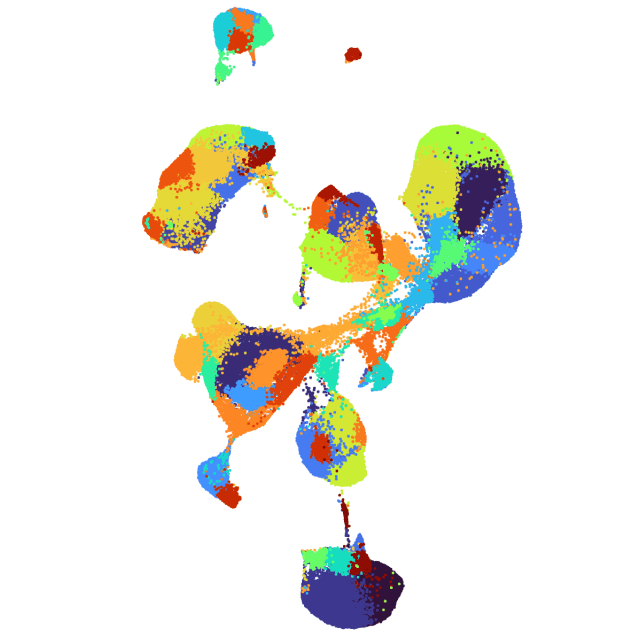
- Approximately 33,511 total cells detected (Liver: 7,942; Kidney: 5,980; Large Intestine: 9,271; Testis: 10,318)
Assay workflow
Gene Expression libraries were generated as described in the GEM-X Flex v2 User Guide (CG000834, Rev C). The dissociated samples were processed in four hybridization reactions. After hybridization, samples were pooled in equal proportions, washed, and then run in a single GEM lane.
- Instrument: Chromium X
- Probe set: Chromium Rat Transcriptome Probe Set v2.0.0
- Probe Barcode IDs: A-A03, A-B03, A-C03, A-D03 (Barcode Oligo Plate Set A)
- Cells loaded: 20,000
Sequencing
- Sequencing instrument: Illumina NovaSeq X Plus, Illumina NovaSeq 6000
- Sequencing configuration: Paired-end, dual indexing: 54 cycles Read 1, 10 cycles i7, 10 cycles i5, 50 cycles Read 2
- Sequencing depth: ~52k read pairs per cell
Analysis
Cell Ranger v10.1 was used with the cellranger multi pipeline to demultiplex the samples, map reads to the reference, and output feature-barcode matrices for further analysis.
How to view data
To get started, download Loupe Browser v9.1 to explore the Loupe file, or read more about the other Cell Ranger outputs.
This dataset is licensed under the Creative Commons Attribution 4.0 International (CC BY 4.0) license. 10x citation guidelines available here.