Cell type annotation refers to the process of categorizing and assigning cell types to individual cells based on their gene expression profiles. These annotations are needed for understanding the cellular composition and diversity within a sample.
Space Ranger v4.1 introduced support for automated cell type annotation as part of the spaceranger count command and as a standalone command, spaceranger annotate.
To generate automated cell type annotations, ensure your analysis includes a Visium HD or Visium HD 3' library.
For cloud-based models:
- Your sample must be from a human or mouse.
- The total number of cells in your analysis should range from 100 to 1.2 million.
- You must have a 10x Genomics Cloud Analysis account.
For the Pan-Human Azimuth model:
- Only human samples are supported.
- A 10x Genomics Cloud Analysis account is not required.
To run automated 10x Genomics cell type annotations with the spaceranger annotate command, you will need to access the 10x Genomics Cloud CLI Access Token.
There are two ways of accessing the token:
- Run
spaceranger cloud auth setup(recommended):
Space Ranger v4.1 introduced a new command, spaceranger cloud auth setup, to simplify the process of authenticating with 10x Genomics Cloud Analysis. This command provides an interactive walkthrough that guides you step-by-step through the setup.
When you run the command:
- You will be prompted to visit the 10x Genomics Cloud Analysis site, where you can generate an access token.
- After copying the token, paste it back into the command prompt, allowing Space Ranger to save the token locally.
Once saved, the token is automatically reused for future requests, making it easier to access Cloud Analysis services without needing to repeatedly enter credentials.
- Manually create a token file
The token is located on the security page of your Cloud Analysis account: https://cloud.10xgenomics.com/account/security.
You have the option to either generate a new token or copy an existing one.
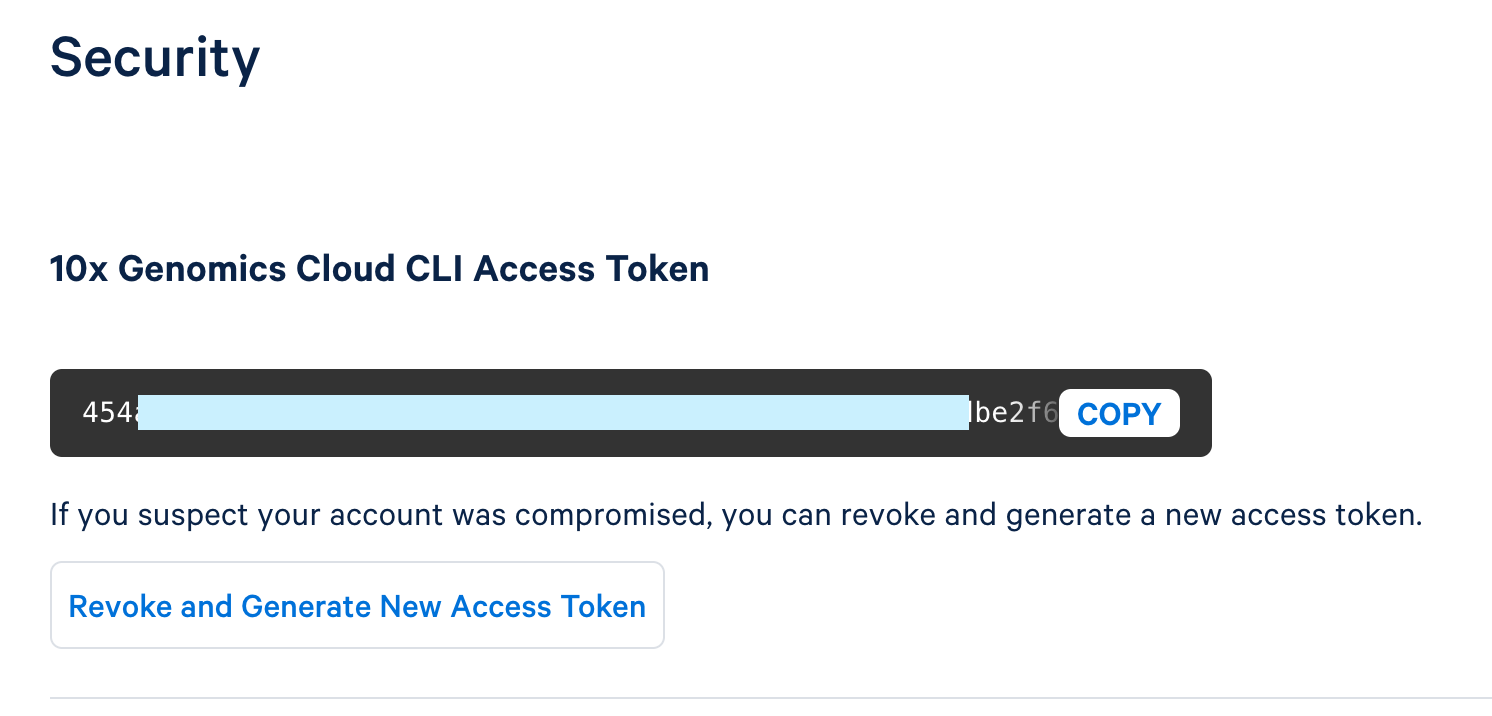
To create a new token, click "Generate New Access Token."
Once the token is generated, use the copy button to copy the entire token and save it as a plain text file in a secure location that others cannot access. This token controls access to data stored in your 10x Cloud Account.
This token file is required as an input with a local installation (i.e., not running in 10x Cloud) to run spaceranger annotate and spaceranger count. When using these pipelines, you will provide a path to the token file via the --tenx-cloud-token-path argument.
The inputs for spaceranger annotate are files generated by the spaceranger count pipeline for Visium HD data.
Specifically, spaceranger annotate requires the following files, located in the outs/ directory of a typical spaceranger count run:
- Filtered feature-barcode matrix in H5 format. It is highly recommended to use the cell-segmented version, not the binned version. All annotation models were trained on single cell data and will not perform as intended when bins are used.
- Loupe Browser file (
.cloupe) (Optional): If you wantspaceranger annotateto generate an annotated.cloupefile as part of the output, include this file as an input. The.cloupefile provides a visual representation of the gene expression data, which can be used in the Loupe Browser to explore the results interactively. If you do not provide a.cloupefile,spaceranger annotatewill still run, but it cannot produce an annotated.cloupeoutput.
Visit the command line arguments page or run spaceranger annotate --help for a full list of accepted arguments.
An example command looks like this:
spaceranger annotate --id=sample123 \
--matrix=filtered_feature_bc_matrix.h5 \
--cell-annotation-model=auto \
--tenx-cloud-token-path=/path/to/10xcloud_token.json
In this example:
--matrixspecifies the path to the filtered feature-barcode matrix in H5 format.--cell-annotation-modeldetermines the 10x Genomics cloud-based model used for cell type annotation. When set toauto, the pipeline automatically selects the appropriate model(s). Currently available models arehuman_pca_v1_beta(10x human model),mouse_pca_v1_beta(10x mouse model).--tenx-cloud-token-pathis the path to the 10x Genomics Cloud Access Token, which is necessary for communication with the cloud-based models. If not supplied, will default to the location stored through spaceranger cloud auth setup. If the token file does not exist, there is an error.- If you do not provide
--cell-annotation-modeland your sample is derived from a human, the Pan-Human Azimuth model will still be run locally.
Cell type annotation generates the same output files, whether run as a standalone annotate command or integrated into the count pipeline. All outputs are saved in the outs/ directory. For more details, see the Cell Type Annotation Outputs page.