Now that we know how bulk and single cell RNA-seq work, let’s go deeper into their unique applications. What kind of questions can each technology answer? What are their strengths and ideal use cases?
Let’s be clear: bulk and single cell analysis have a place in all kinds of research settings, and both have enabled incredible discoveries. But there are inherent limitations to an average gene expression readout. Bulk naturally has more constrained applications. So in what biological use cases does a single cell readout provide a particular advantage? What research questions can only be answered with a complete view of cellular heterogeneity?
Before we dive in, let’s first explore some of the powerful applications of bulk RNA-seq and how it can work together with single cell analysis.
[Jump ahead to single cell applications and publications]
Applications of bulk RNA-seq
Since bulk readouts provide an aggregate view of the sample's gene expression profile, some key use cases for this approach include:
-
Differential gene expression analysis: By comparing bulk gene expression profiles between different experimental conditions, including disease vs. healthy, treated vs. control, sequential developmental stages, or time-course experiments, you can identify the distinct genes that are upregulated or downregulated in these conditions. This can also support applications like:
- Discovery of RNA-based biomarkers and molecular signatures for diagnosis, prognosis, or stratification of diseases
- Investigating how sets of genes (pathways and networks) change collectively under various biological conditions
-
Tissue or population-level transcriptomics: Bulk data can also help you obtain a global expression profile from whole tissues, organs, or bulk-sorted cell populations. This population-level analysis can be useful for:
- Providing baseline transcriptomic profiles for new or understudied organisms or tissues
- Supporting deconvolution studies with single cell RNA-sequencing reference maps
-
Identifying and characterizing novel transcripts: Bulk data can be used to annotate isoforms, non-coding RNAs, alternative splicing events, and gene fusions (1)—albeit with limited functional insights since you can’t resolve the specific cell type or state transcripts originate from.

Where bulk and single cell fit into large cohort studies
Historically, cost and logistics pushed large cohort and biobank studies toward bulk RNA-seq. That tradeoff is shifting as newer technologies make population-scale single cell profiling cost-competitive while resolving the cell-type-specific effects bulk misses. See examples of population-scale single cell studies in this white paper.
Applications of single cell RNA-seq
Single cell RNA-seq provides a readout of the gene expression or multiomic profiles of individual cells. With this foundational capability, you can answer new categories of questions to reach a deeper understanding of your sample and its underlying biology:
Characterizing heterogeneous cell populations, including novel cell types, cell states, and rare cell types
- What cell types or states are present in a tissue (e.g., neurons vs. astrocytes in brain tissue)?
- What are the proportions of different cell types or states?
- What are the gene expression differences between similar cell types or subpopulations (e.g., different subtypes of T cells)?
- How do gene expression programs vary within a supposedly homogeneous cell type (e.g., cycling vs. quiescent states, activated vs. resting immune cells)?
- Are there rare cell types or transient states that play key roles in biology?
Discovering new cell markers and regulatory pathways
- What are the co-expression patterns of genes at the single cell level?
- How does knocking out certain genes affect other gene programs in unique cell populations? (See how single cell CRISPR screens make this one possible.)
Reconstructing developmental trajectories and lineage relationships
- How does cellular heterogeneity evolve over time (e.g., during development or disease progression)?
Profiling healthy and diseased tissue, organs, and systems
- How do individual cells respond to stimuli or perturbations, such as treatment or disease conditions?
- Are certain cells or cell states the major drivers of disease biology or treatment resistance?
Here’s a real answer to that last question:
Bulk and single cell RNA-seq reveal the cellular culprit behind drug resistance in B-ALL
Sometimes, two is better than one. Bulk and single cell RNA-seq can work together to provide a deeper understanding of biology and do more than one technology could do alone.
One example comes from a 2024 Cancer Cell paper: a team of St. Jude’s researchers used bulk and single cell RNA-seq in healthy human B cells and clinical samples to identify the cell state driving resistance to asparaginase, a chemo drug commonly used to treat B-cell acute lymphoblastic leukemia (B-ALL).
The team's use of bulk and single cell together started with a problem: they had bulk RNA-seq profiles from nearly 2,000 B-ALL patient samples, but bulk data alone can't tell you which cell types are actually in the mix. So they used a single cell reference atlas of healthy B-cell development—built from Human Cell Atlas bone marrow data—as a decoder. Running it through an algorithm called CIBERSORTx, they deconvoluted the bulk profiles to estimate how much of each B-cell developmental stage was present across patient samples. That's when it became clear: resistant cases had a much higher proportion of pre-pro-B-like cells, pointing them directly at the likely culprit behind asparaginase resistance (and, eventually, to a new target for combination therapy.)
Read the full story in this blog →
What only single cell RNA-seq can do: Specificity in the midst of heterogeneity
At its most basic application, single cell RNA-seq provides a way to catalog cell types—resolving who's in the tissue and what each cell is doing. What was once a population-level view of the cells in a tissue with bulk RNA-seq is now a high-definition view of each individual cell type and state.
It’s a powerful discovery tool and a prerequisite for understanding which cells drive disease or escape therapies and identifying the right targets for intervention. With a clear picture of biological complexity, you can ask more specific, impactful questions: from “does this drug work on this tumor?” to “does it work on the specific cells that are driving resistance?”
Single cell discovery is then the foundation for breakthroughs across research fields and aims, like identifying and profiling important cell types or revealing disease mechanisms. See how in the following publications:
Finding the cellular source of the cystic fibrosis mutation
Scientists discovered that the "pulmonary ionocyte," a previously uncharacterized cell type that makes up a mere 0.5% of all lung cells, is the main source of the mutated CFTR gene causing cystic fibrosis pathology (2).
Hidden cell states drive the efficacy gap between two CAR-T therapies
Single cell analysis of two different CAR T-cell products used to treat large B-cell lymphoma revealed cell states underlying the observed difference in real-world efficacy and that the manufacturing workflow was decreasing naïve and central memory T-cell subsets in the less effective drug (3).
A blood signature predicts treatment response in non-Hodgkin lymphoma
Single cell profiling of the peripheral immune landscape before treatment with NKX019, a CD19-targeting CAR natural killer cell therapy, in non-Hodgkin lymphoma pointed to candidate immune biomarkers for clinical response and resistance, and possible strategies for patient stratification (4).
Read about the study and clinical trial.
Revealing cellular programs underlying severe COVID-19 pathology
A single cell atlas study of severe COVID-19 autopsy tissue revealed that myeloid and epithelial cells were the primary cell types enriched for SARS-CoV-2 RNA and pointed to a cellular mechanism for lung failure (5).
Identifying immune-checkpoint-resistant cell states in melanoma
In their search for more durable therapeutic approaches for individuals with melanoma, researchers leveraged single cell RNA sequencing to reveal malignant cell states associated with immune checkpoint inhibitor resistance (6).
Tracing fragile neutrophils in clinical samples
Neutrophil gene expression signatures are emerging biomarkers for a range of human diseases, but their fragile nature requires sample stabilization. Flex was able to preserve neutrophil biology and provide the highest transcriptome quality from clinical samples, justifying its use in clinical trial workflows (7).

Your single cell publication library
Find more discoveries enabled by single cell technology in this database of 10,000+ peer-reviewed, published papers.
Creating large-scale data sources for AI modeling
There’s one capability we haven’t touched on yet that only single cell RNA-seq can provide.
Data.
Large-scale, high-quality single cell datasets provide a foundation to train AI models that represent the future of biological research. Arc Institute’s virtual cell atlas, Chan Zuckerberg’s Billion Cells Project, and many other pioneering AI initiatives fundamentally rely on single cell data because average isn’t good enough for those models and the kind of impact on human health that scientists want to make with them.
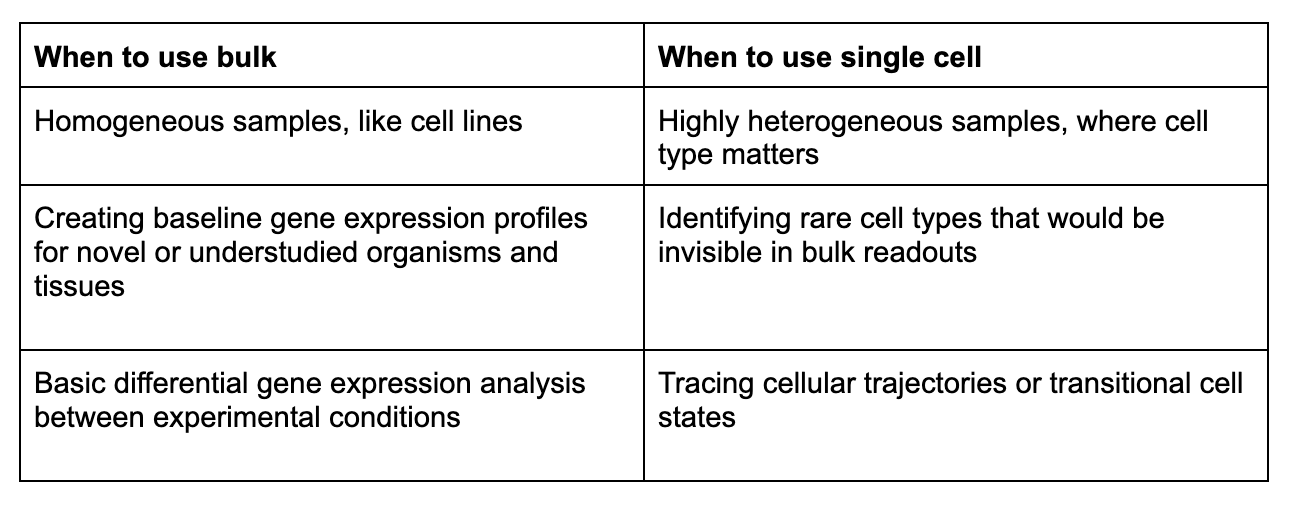
Next steps: A decision guide for single cell vs. bulk RNA-seq
These general use cases can help you figure out which approach makes sense for your research—bulk or single cell?
Ready to get started with single cell? Talk to a technology specialist about your projects and goals.
References:
- https://sampled.com/bulk-rna-sequencing-vs-single-cell-rna-sequencing/
- Montoro D, et al. A revised airway epithelial hierarchy includes CFTR-expressing ionocytes. Nature 560: 319–324 (2018). doi: 10.1038/s41586-018-0393-7
- Yu X, et al. Comparison of axicabtagene ciloleucel and tisagenlecleucel patient CAR-T cell products by single-cell RNA sequencing. J Immunother Cancer 13: e011807 (2025). doi: 10.1136/jitc-2025-011807
- Yu K, et al. Single cell RNA and TCR sequencing reveal candidate immune biomarkers of NKX019 clinical response in Non-Hodgkin Lymphoma (NHL). J Immunother Cancer 13 (2025). doi: 10.1136/jitc-2025-SITC2025.0558
- Delorey TM, et al. COVID-19 tissue atlases reveal SARS-CoV-2 pathology and cellular targets. Nature 595: 107–113 (2021). doi: 10.1038/s41586-021-03570-8
- Jerby-Arnon L, et al. A cancer cell program promotes T cell exclusion and resistance to checkpoint blockade. Cell 175: 984–997.e24 (2018). doi: 10.1016/j.cell.2018.09.006
- Hatje K, et al. Comparison of single-cell RNA-seq methods to enable transcriptome profiling of neutrophils in clinical samples. Cell Rep Methods 5: 101173 (2025). doi: 10.1016/j.crmeth.2025.101173