You’re considering a gene expression profiling technology for your next research project. But which one should you choose?
We’ve discussed the technical differences between the big two—single cell and bulk RNA-seq—and their different biological applications. Those are both great places to start to understand which platform may best fit your experimental goals.
But you may have other practical considerations: how much does it cost? How long does it take? How challenging is the protocol or data analysis? In other words, are there trade-offs that you’ll have to make, paying a cost in one way to take greater advantage in another.
Like buying a car, you may need to test it out and see. But this blog will give you a head start to know what to expect. Typically, you're going to compare bulk and single cell RNA-seq on factors like cost, data resolution and quality, and cellular or sample throughput—all of which affect your potential for biological discovery and real-world impact.
We’ll start generally. Jump ahead to explore a quick breakdown of:
Then, we’ll get into the specifics and look at the latest single cell capabilities from 10x, like new assays and automation that lower costs, simplify hands-on workflows, and accelerate data analysis.
Advantages and disadvantages of bulk RNA-seq
Bulk RNA-seq is a lower-cost option for whole transcriptome analysis. It provides an averaged, sample-level view of gene expression rather than resolving individual cell differences. Lower sequencing depth cuts costs, and simpler sample prep with lower-resolution output makes for an easier workflow and analysis.
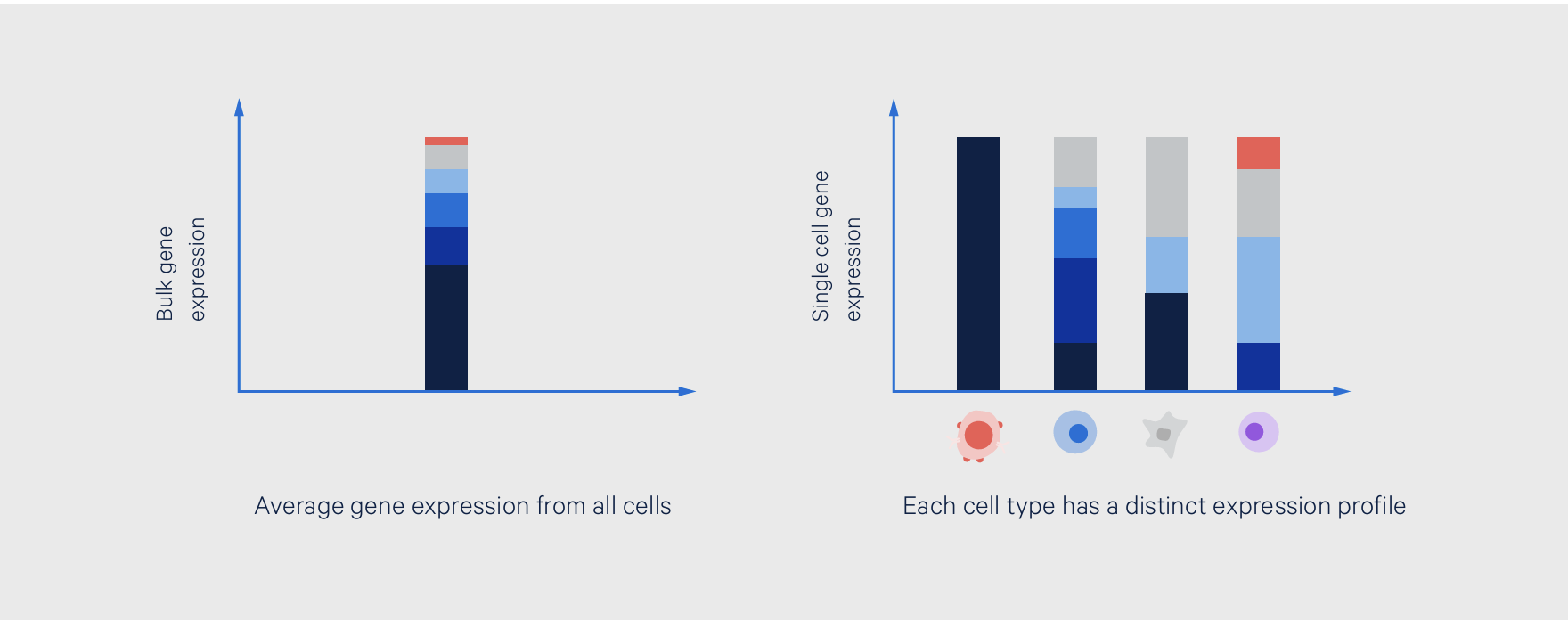
But these advantages come with major tradeoffs in resolution and the potential for discovery. Because bulk RNA-seq provides an average readout of gene expression across all the cells in a sample, it can’t tease apart the cellular origins of gene expression readouts. It’s impossible to know from a bulk readout if one or a few cell types are the majority producers of a certain gene or unique transcript.
In short: a bulk readout can’t reveal the cellular heterogeneity of a sample, while single cell sequencing reveals the breadth of cell types in a complex tissue (Figure 1), even resolving rare, low-abundance cell types that could be driving unique gene expression profiles.
Advantages and disadvantages of single cell RNA-seq
Single cell RNA-seq delivers whole transcriptome cellular profiles for individual cells, which uncovers cellular heterogeneity in a way that bulk simply can’t. Single cell technology from 10x Genomics comes with the added benefits of a robust, reproducible, instrument-enabled workflow that reduces error by automating steps, ensuring the highest data quality. Automation also enables greater scale, which can reduce cost per cell to run single cell assays.
But there’s a tradeoff: single cell workflows carry perceived barriers of cost and complexity. Single cell RNA-seq usually costs more than bulk partly because it requires deeper sequencing to capture rare features. You also have to dissociate samples into a single cell suspension with high cell viability, or jump into unfamiliar data analysis techniques, making scRNA-seq a more advanced experiment.
But don’t discount the value that single cell analysis can bring to your research—revealing hidden cells, disease mechanisms, and biomarkers, while supplying high-resolution data to train AI models, to list a few possibilities.
Plus, the apparent challenges with single cell approaches are steadily being addressed, making the technique more accessible than ever. See how we're tackling:
Cost
Cost is often the biggest barrier for researchers moving from bulk to single cell. But the low per-sample cost of bulk analysis doesn't always translate to long-term savings. Without high resolution, you could miss a new cell type or a low-level transcript key to moving your project forward (or publishing in a high-impact journal).
With 10x Genomics technologies, you not only get single cell resolution, but also higher gene sensitivity, fewer errors, and the confidence to get it right the first time. And we’re continuously innovating to lower costs:
- The Flex Apex assay is bringing down cost per cell by enabling high-throughput single cell experiments, including the ability to run up to 384 samples a week in a 96-well format. Plus, Flex maximizes your sequencing budget with highly sensitive transcript detection.
- GEM-X Universal 3’ and 5’ Multiplex assays are lowering per-sample costs with smaller kit options that let you input less of your sample and use fewer reagents.
- The Chromium Xo instrument offers an affordable entry point to high-performance single cell profiling with our Universal 3' Gene Expression assay.
- Automation capabilities, compatible with the range of 10x single cell assays, can drive up the scale of your single cell experiments while driving down cost per cell.
- The QuantumScale Single Cell RNA Sequencing Kit enables large-scale single cell studies that require reverse transcription, including high sample or plate-based screens. Again, greater scale brings down costs per cell or sample.
Experimental difficulty
New sample prep requirements and an unfamiliar instrument-based workflow may seem daunting, but, in reality, every single cell experiment follows three common steps that are similar to a bulk experiment: sample prep, running the assay, and data analysis (Figure 2).

And you’re not alone to figure it out. You have 40+ Demonstrated Protocols across our Chromium Single Cell portfolio, explainer videos, and detailed User Guides to help you succeed. Your local 10x Field Application Scientist can give you expert guidance through sample prep and experimental design, too.
Then, push a button and walk away. That’s what the Chromium X instrument series gives you: confidence to spend your time on other things and superior reproducibility. Automating the partitioning steps of a single cell workflow (Figure 3) minimizes errors from manual workflow pipetting. If you aren’t ready to own an instrument, you can work with one of the many core facilities that offer Chromium Single Cell services.
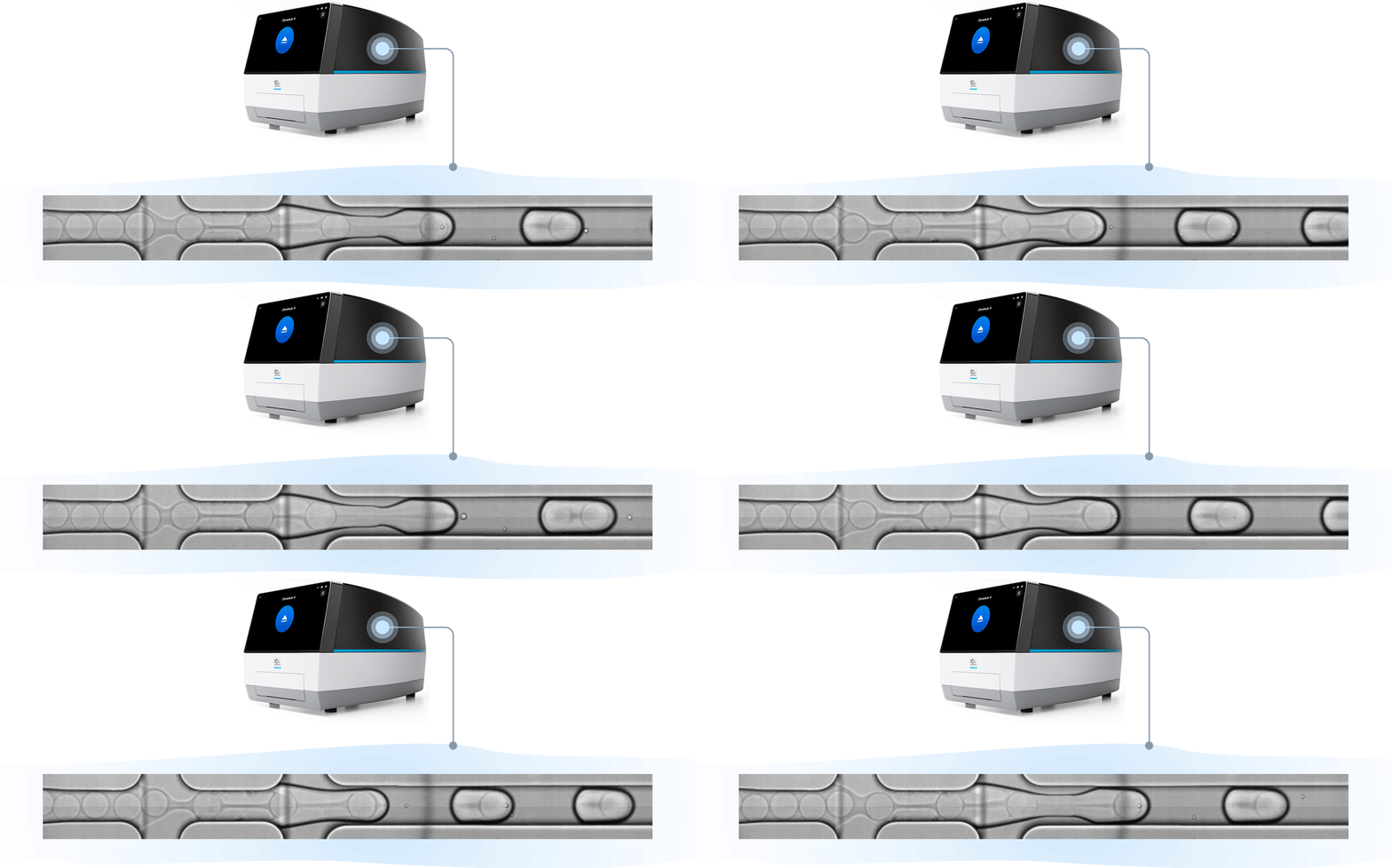
The results speak for themselves: you get more from every sample with up to 80% cell recovery, even from low cell inputs or samples with fragile cells. And you get consistent performance with an R² of 0.97 across runs, users, and timepoints.
Learn more about Chromium Single Cell workflows, built for your success.
Data analysis
Single cell data can be accessible and interpretable, no bioinformatics experience needed. Our free, user-friendly software and training resources are designed to help you get straight to biological exploration:
- Cell Ranger pipelines process scRNA-seq data in as little as an hour with free 10x Genomics Cloud Analysis.
- You can easily visualize genes and clusters with Loupe Browser software.
- Automated cell annotation capabilities are also streamlining analysis.
- Our 8-week online data analysis course equips you to perform your own analysis with 10x pipelines and community tools.
- Our Analysis Guides offer a variety of helpful tutorials and FAQ blogs, from the basics to advanced analysis techniques.
With these resources, you can identify cell types and states, detect rare transcripts, perform multi-sample comparisons, and explore new questions that only single cell data makes possible.

Explore your options for single cell assays
If you want to go deeper into what’s possible with single cell RNA-seq, this next blog introduces our assay families, Flex and Universal. Explore their respective uses and practical considerations, like sample compatibility, throughput, and more, to find the right fit for your research.
If you’re ready to get started with single cell, reach out to a technology specialist to talk about your projects and goals.