Single cell with confidence, at every workflow step
Optimized sample prep for any single cell possibility

Access more sample types
Capture data from a wide range of species with our reverse transcription (RT)-based Universal assay
Expand the scope of your studies to include FFPE samples with our probe-based Flex assays
Easily isolate nuclei from frozen samples with kitted reagents and a unified workflow
Scale with flexible throughputs
Easily move from pilot studies to ambitious experiments with the ability to process 1–3,072 samples, and profile hundreds to millions of cells per run
Batch and run assays on your schedule with robust fixation protocols, even for whole blood samples
Increase efficiency with multiplex options
Reduce reagent volumes and costs with easy on-chip multiplexing for Universal 3' and 5' assays
Use plate-based multiplexing for fixed samples to profile up to 8M cells per run and enable sample batching
Automated cell partitioning & barcoding

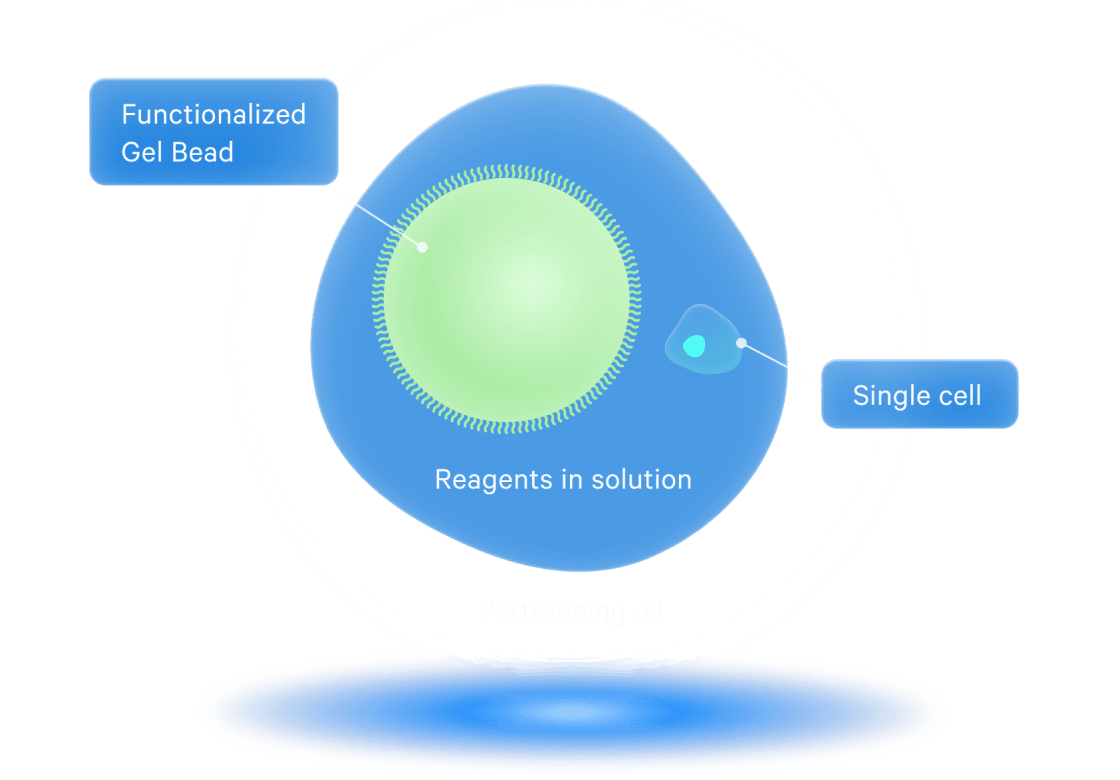
GEMs: The core of Chromium Single Cell technology
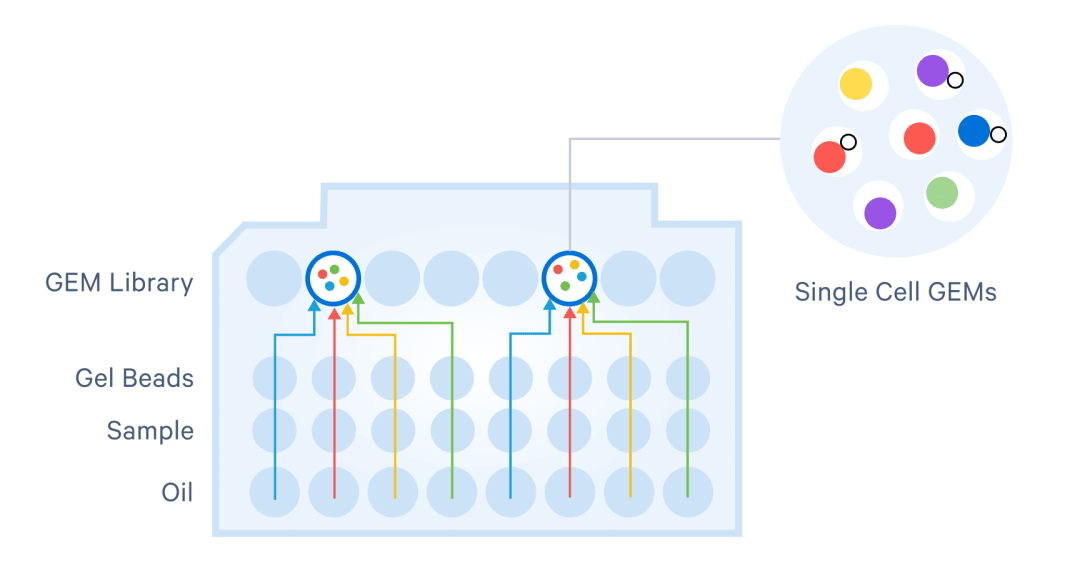
Within Chromium X series instruments, cells move through the channels at a limiting dilution, generating 10,000+ nanometer-sized Gel Beads-in-emulsion (GEMs) in 4 minutes. Each GEM is the site of a micro-reaction, in which Gel Beads are dissolved and target molecules from each cell are captured and barcoded, marking each target molecule's cell of origin.
The Chromium instrument advantage
Did you know? Chromium X series instruments automate the most critical steps in single cell assays: partitioning and barcoding. These fast, efficient workflows reduce technical errors and batch effects common in labor-intensive, time-consuming manual workflows. Plus, the instruments combined with GEM-X advancements deliver industry-leading cell capture of up to 80% and superior reproducibility.
MiSeq
NextSeq 500/550/2000
HiSeq 2500 (Rapid Run)
HiSeq 3000/4000
NovaSeq 6000
Explore your data and make discoveries—no bioinformatics experience needed

Unlock downstream analysis with Cell Ranger, our easy-to-use pipelines that set the standard for scRNA-seq data processing
Get results quickly and run Cell Ranger pipelines on 10x Genomics Cloud Analysis, our optimized cloud infrastructure
Visualize your processed data with the interactive Loupe Browser, quickly plotting differential expression of your favorite genes
Take advantage of continued innovations for new features like automated cell annotation
Versatile chemistries support a large range of inputs, applications & scales

Probe-based assays
Uses probe sets against 18,000+ coding genes from human, mouse, or rat alongside protein readouts for fresh, frozen, and fixed samples
Why choose probe-based Flex assays?
Three-fold coverage of targets for high sensitivity and exceptional performance for FFPE and low-quality samples
Run large-scale studies (up to 384 samples a week) with convenient, plate-based multiplexing

Reverse transcription (RT)-based assays
Captures the whole transcriptome alongside multiomic options (protein, CRISPR, BCR/TCR-seq, or open chromatin)
Why choose the RT-based Universal 3' or 5' assays?
Gather broad information (isoforms, single nucleotide polymorphisms, long non-coding RNAs, etc.) from diverse species
Bring easy multiplexing to samples that can't be tagged (e.g., non-human/mouse, or nuclei) or samples that are limited
Streamlined multiplexing for flexible scaling & higher efficiency
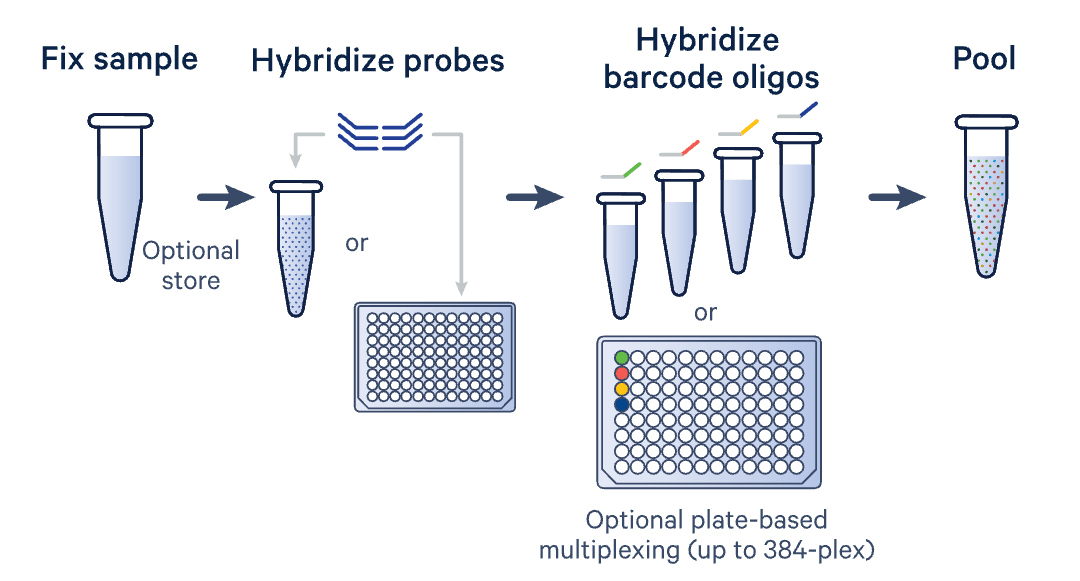
Plate-based multiplexing and flexible batching with Flex Apex
Why choose multiplexing with Apex?
Increase scale dramatically with convenient 96-well multiplexing and automation compatibility
Batch and multiplex to enable your largest studies, processing up to 384 samples or up to 100M cells per week
Scale at your pace by running partial plates, using only the reagents you need, when you need them
On-chip multiplexing for Universal 3' & 5' assays
Why choose on-chip multiplexing for Universal assays?
Co-partition cells from four samples, collect all GEMs in the same recovery well, and demultiplex samples computationally after sequencing
Process 1–8 samples and up to 40K cells/chip , with on-chip multiplexing for for any study, even at small scale
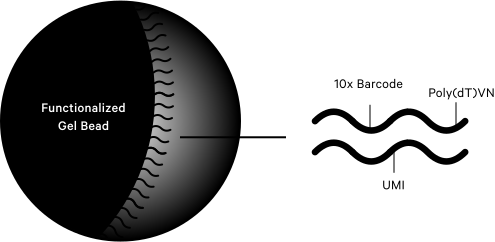
Add multiplexing to your workflow easily without the need to tag samples upstream of chip loading